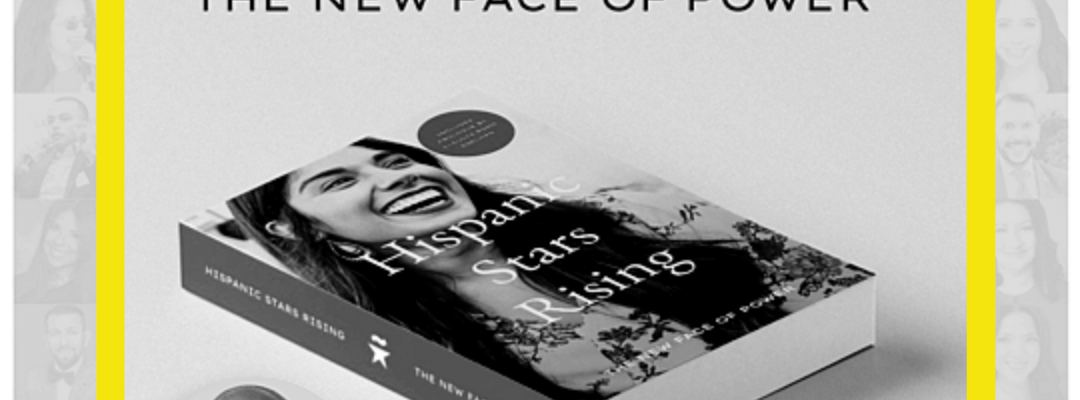
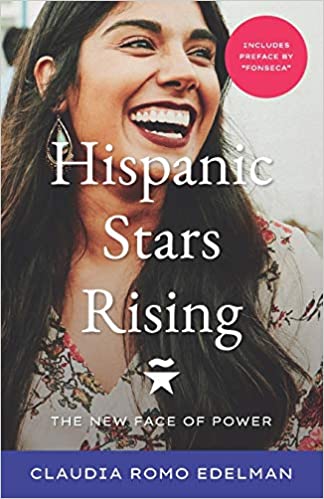
This new book contains ninety personal stories written by U.S. Hispanics in 2020. Published in November 2020 by Fig Factor Media and edited by Claudia Romo Edelman and The Hispanic Star initiative, the book also includes a preface by the Colombian musician “Fonseca.”
From the back cover:
“Hispanics are 100% Hispanic and 100% American. They believe in the American dream and are incredible contributors to this country. US Hispanics represent 60 million people, 18% of the population, 12% of the country’s GDP, $1.7 trillion of purchasing power, the youth population, and the list goes on! Yet, they are often invisible, negatively portrayed, and seen as takers. Hispanics contribute so much to America, and now it is time for others to see just how beautiful and resilient they can be. Hispanic Stars Rising: The New Face of Power shares the stories about the experiences, challenges, and successes of Hispanic Stars nationwide. It showcases the diverse backgrounds, obstacles, and contributions made by this strong and resilient population nationwide and shines a light on the beauty of this fundamental American community.”
An excerpt of Antonio Nunez’s essay The Day Piquito de Oro Died in Chicago:
“This time, I landed in Chicago. I had just been hired by an advertising agency specifically because I was good with words. I have been a “pico de oro” (silver tongue) since I was a kid. Being a professional public speaker was my profession in Spain, where I was born.
My first day at work. The ad agency was at the Merchandise Mart, the world’s biggest building in 1930. It’s a structure so gigantic that it has its own zip code. After half an hour wandering around those Art Deco corridors and stumbling upon the same bronze bust for the third time, I had to do what men hate most: admit that I was utterly lost.
I stopped a good Samaritan and did the second thing men hate most, asking for directions. The instant I pronounced a few words, the chap looked at my mouth in shock. The more I spoke, the more he looked at it, staring with a mix of confusion and genuine curiosity. I felt that he was about to grab my chin and open my mouth wide to study it, and decided to leave. Then I tried asking a middle-aged woman. From what I perceived to be gibberish, all I could understand was that she was very, very sorry. Finally, I spotted someone who was brown like me. This Latino executive patiently answered my question, speaking with perfect vocalization. “YOUR-ACCENT-IS-SO-THICK-THAT-
I was perplexed. My first stint in the US had been in Miami, and nobody ever had an issue with my accent. Besides, if the executive was Latino, was it true that he didn’t speak Spanish?
In the Midwest, what in Miami sounded fluid, like Mozart, it landed as an Egyptian hieroglyphic. I learned the hard way about the assumptions people can make when you have a Latino accent. “Piquito de oro” died. I lost my confidence and self-esteem. I was not myself anymore. The worst part was (…)
More information about the book here:
What this book shows is not just representation—it shows the power of narrative to redefine how a community sees itself and how others see it.
For companies, the challenge is similar: not just communicating what they do, but also shaping the story that gives it meaning.
That’s where corporate storytelling becomes a strategic tool—clarifying positioning, aligning teams, and creating impact beyond campaigns.
If your organization is navigating that challenge, this is exactly the work I focus on.
You can explore how I approach corporate storytelling and brand narrative here.